Author: knguyen

  • My First Hometown

    Image from Vinpearl, “Phan Thiet, Vietnam: A tropical paradise with golden sunshine and dry wind”

    While I’ve lived in Seattle for more than half of my life and I consider the city my second hometown, my first hometown where I was born and raised is Phan Thiet, a coastal city in Southeast Vietnam and the capital city of what used to be Binh Thuan Province before the restructure in 2025.

    Image from Agoda, “Welcome to Phan Thiet: A Journey Through Culture and Serenity”

    Being a coastal city, Phan Thiet is known for fishing villages with vibrant colorful boats and outdoor fish markets where the locals would buy and sell fresh seafood everyday. As a child, I remember days where my family would go to the beach as early as 5am where I and my siblings would go play in the water and the sand while my mom would go shop for seafood. Phan Thiet has a tropical savanna climate, characterized as hot, dry and windy. In contrast to Seattle or the U.S. where people would go to the beach when it’s hot and sunny out, Phan Thiet locals go to the beach early in the morning or late in the afternoon to avoid sun exposure.

    Image from Vinpearl, “Sand dunes in Mui Ne: Best spots for unique desert experiences in Vietnam”

    Phan Thiet is also famous for red and while sand dunes located 25 kilometers from the city center where tourist can enjoy jeep tour riding through the desert or sliding down the sandy hills. It is a perfect destination for photography and capturing the sunset.

    Image from Vietnam Luxury Travel, “Poshanu Cham Towers: A Timeless Symbol of Champa Culture in Phan Thiet”

    The city also offers rich culture and history with famous landmarks such as Poshanu Cham Towers and Ta Cu Mountain & Lying Buddha.

    Poshanu Cham Towers are a symbol of Champa culture influenced by Hinduism and Buddhism. These towers are characterized by ancient red-brick structures built by the Champa Kingdom in the 8th-century to worship Hindu deities.

    Ta Cu Mountain is home to Linh Son Truong Tho Pagoda and the longest Lying Buddha statue in Vietnam. The Lying Buddha statue is surrounded by lush green forest and sacred spiritual atmosphere. Visitors to the mountain and choose to hike, which takes an average between 2-3 hours, or enjoy a 10-minute cable car ride up to the temple.


    Lying Buddha, Image from Du Lich Thanh Pho Ho Chi Minh
    Linh Son Truong Tho Pagoda, Image from Du Lich Thanh Pho Ho Chi Minh

    Phan Thiet is becoming a popular tourist destination in recent years with lots of new resorts being built for private beach experience. I haven’t had a chance to revisit some of these places since moving the States but I would hope the city is able to retain its natural beauty alongside boosting tourism.
  • Free Financial Planning Tools

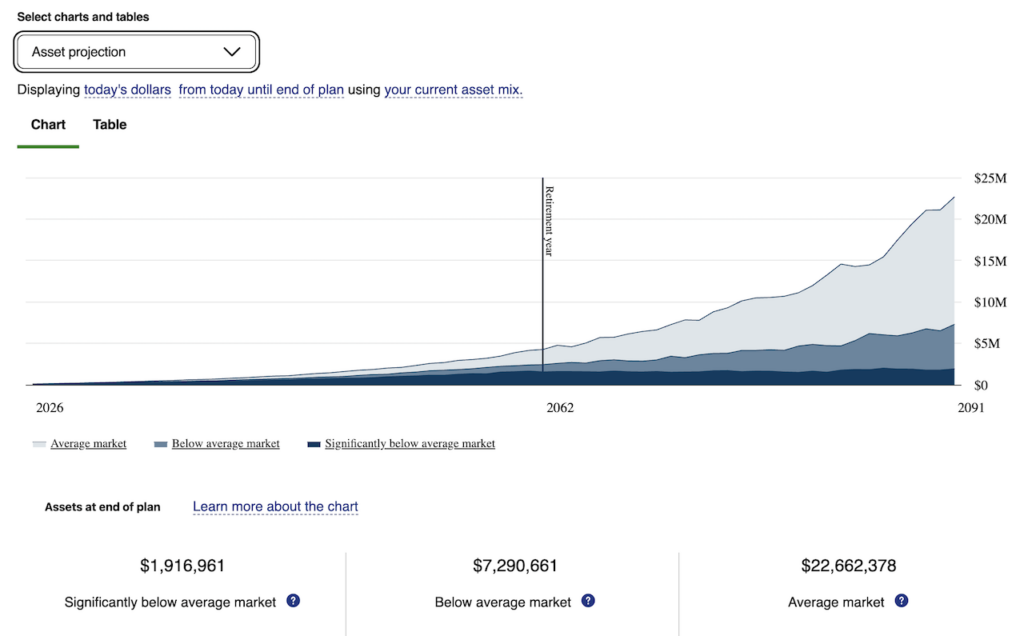
    Fidelity is one of the largest brokerage companies in the world offering financial services including free online financial planning tools. The Fidelity Retirement Planning dashboard allows users to create a personal household profile (income, bonus, commission), retirement profile (retirement age, state, life expectancy), retirement expenses (can use automatic estimate or define user input), current assets (401k, saving, investment, real estate) and retirement income (social security, can use automatic estimate or manual input). The result from the analysis is a basic graph showing projection for 3 different scenarios, average market, below average market and significantly below average market.

    The tool is very simple and easy to use. If the user already has a Fidelity account for 401k or IRA, all of these assets are automatically linked to the tool to be used in the analysis. These types of accounts can also be added manually. The user also has option to manually add in other assets. The analysis result is very easy to interpret and can be viewed with a graph or a table showing the growth of the total assets through each year until the final year of life expectancy.

    Some of the limitations of the tool is that it does not offer different rate of return assumption. Retirement saving rate is set to the user’s current 401k contribution rate and cannot be adjusted easily, which limits the user’s ability to see what happens if they decide to save more or less. It is not clear how the tool takes into account the user’s current expenses and how that factors into their saving plan and retirement projection.

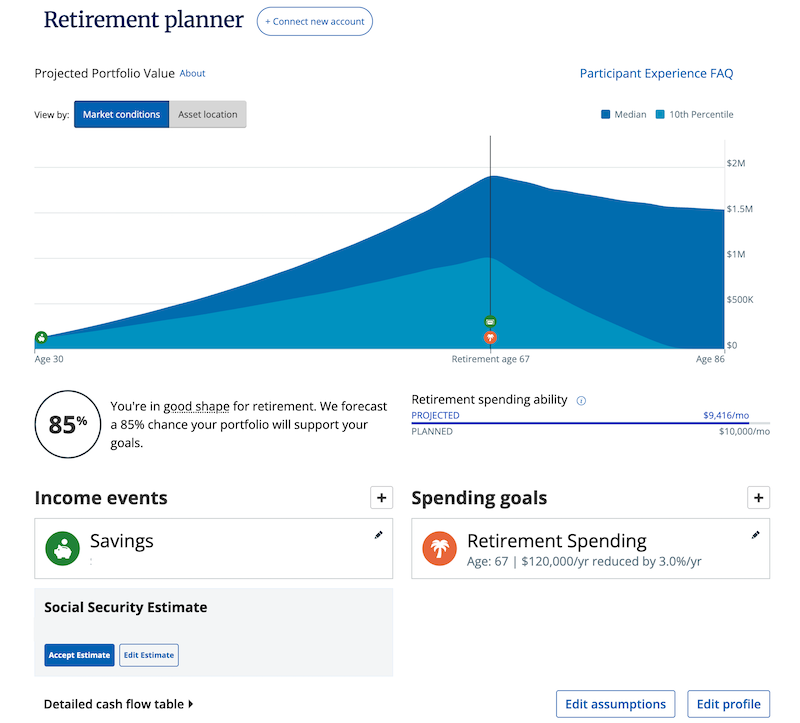
    Empower is another financial services company providing free financial planning tool that allows users to track finances, budgeting and retirement planning. The tool requires setting up an Empower account and link all personal information such as bank accounts, retirement accounts, mortgage, loans, etc. In the retirement planner, the user can input their expected yearly saving, any other cash balance and a percentage of saving increase per year. The user can also adjust retirement age, retirement spending and percentage of spending decrease per year until reaching a spending minimum. There is also a social security estimate provided by the software but can be manually adjusted by the user. There are a few assumptions that the user can manipulate such as effective tax rate, inflation rate and life expectancy. The analysis result shows a graph of the projected portfolio over the projected lifespan with a success rate given in percentage.

    One drawback of the tool is that it requires the user to link personal financial accounts, which might be viewed as a security concern. It also has limited capability in term of making adjustment to saving plan or adding a spouse to the profile. Similar to Fidelity Retirement Planning, this tool assumes a fixed saving rate and does not take into account monthly expenses and how variations might factor into retirement projection.

    On the other hand, one advantage of the tool is that it allows the user to create multiple retirement plans, simulate recession at a certain year during the user’s lifetime, compare these different scenarios and evaluate the rate of success for each plan. Overall, the tool has a very user-friendly interface with an easy learning curve suitable for beginners looking into retirement planning.

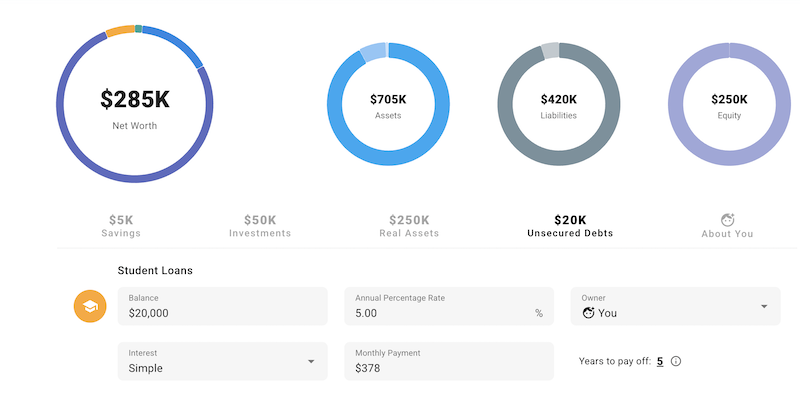
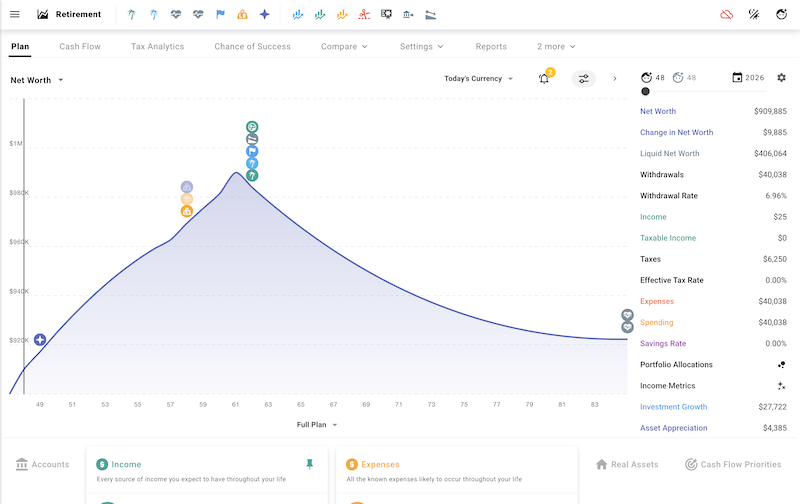
    ProjectionLab Financial Planning tool has a free version as well as premium for advanced users. The free version offers full planning capabilities, but some advanced reporting is limited to premium members only. Aside from the basics, this tool has an option to add life milestones such as getting married, having kids, new jobs or moving to a different place. The user can also input current living expenses and cash flow priorities such as paying debt and mortgage.

    The tool requires the user to manually input all of their information. However, there is no data preservation in the free version, and the user would have to manually input all the numbers again at their next visit. The tool utilizes Monte Carlo probability analysis to simulate the chance of success in reaching retirement goal. A huge drawback of the tool is that it has a high learning curve due to the level of customization and complexity in trying to simulate real life scenarios.

    Fidelity

    Empower

    ProjectionLab

  • HW6 Summary

    Time Log – time spent on other students’ sites:

    Date: Feb 11, 2026, From 9:30pm to 10:00 pm

    Date: Feb. 12, 2026, From 9:15pm to 10:00pm

    Date: Feb. 13, 2026, From 9:30pm to 10:00pm

    Date: Feb. 14, 2026, From 3:00pm to 4:00pm

    Date: Feb. 14, 2026, From 10:00pm to 10:30pm

    Date: Feb. 15, 2026, From 11:30am to 12:00pm

    Date: Feb. 15, 2026, From 5:30pm to 6:00pm

    Essay I. Summary of your activities in your contents including new contents created (one paragraph). Provide all the hyperlinks (clickable) of new contents you have created this week.

    I installed a plug-in Robo Gallery to my website to display images of famous landmarks in Seattle. This gallery can be seen from the homepage. I wanted to add images to my homepage to make it more visually appealing. Image sources are displayed on the bottom left corner.

    Homepage

    I also created a new page called My Learning to include the two new posts that I created this week. The My Learning page is linked below.

    My Learning

    In My Learning page, the two new posts are displayed using an automatic slider. I’ve also added a gallery of recommended books on investment topics at the end of the page with links to buy from Amazon for anyone who is interested. The links to the new posts are below.

    1st post: What is compound interest?

    2nd post: A week as a mechanic

    A HW6 page is added under HWs menu with link below

    HW6

    The HW6 page includes 3 posts, HW6 Summary and the two posts that I created under My Learning.

    I addition to new contents, I also went back and make small changes to my existing menu. I updated the More Links menu page to include links to the practice HTML. I also reformatted the IT Trends page and My Life page to include feature images.

    More Links

    IT Trends

    My Life

    Essay II: Summary of your “Exploration in GA4 (add a screenshot) (one paragraph)

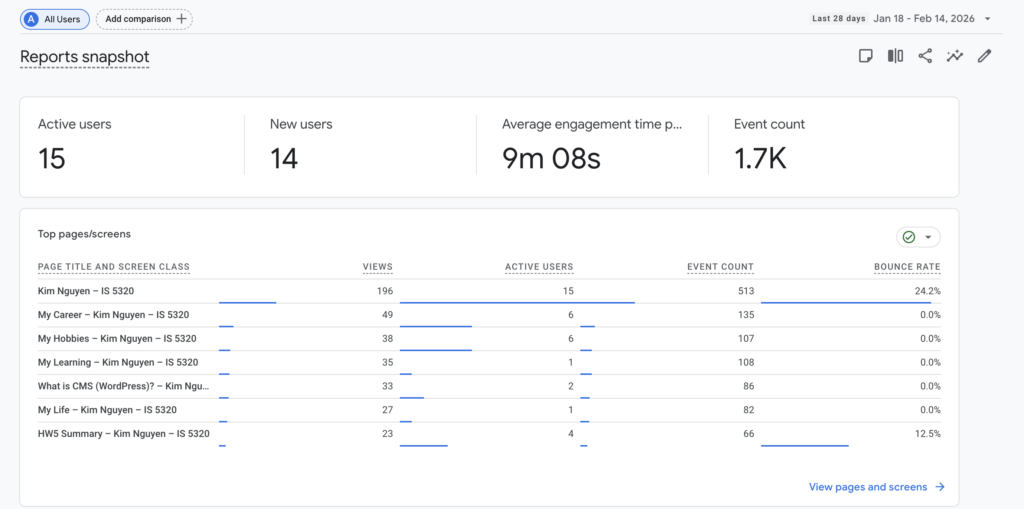
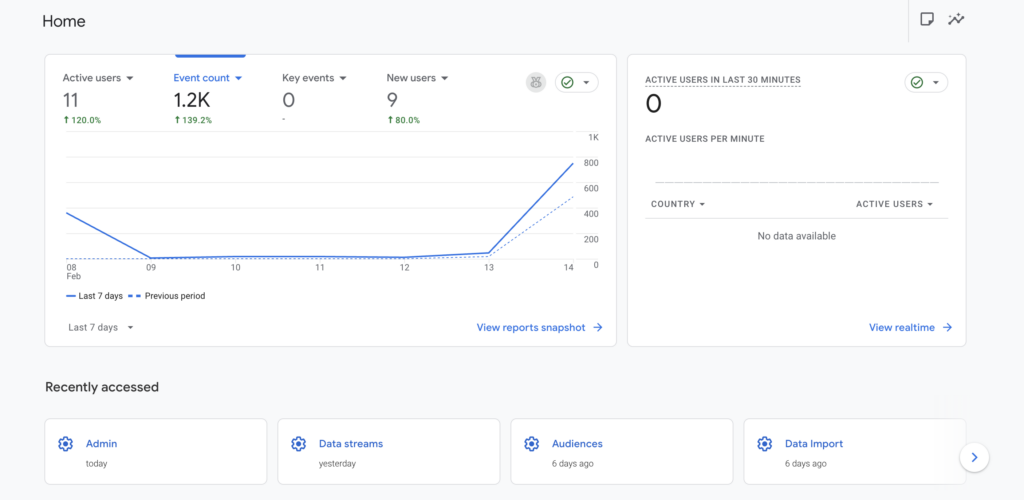
    Below is a screenshot of GA4 user report for my website. There are 14 new users who visited my website. This report also tells me how many views each of my page is getting. Some of the popular posts with the most views are My Career and My Hobbies.

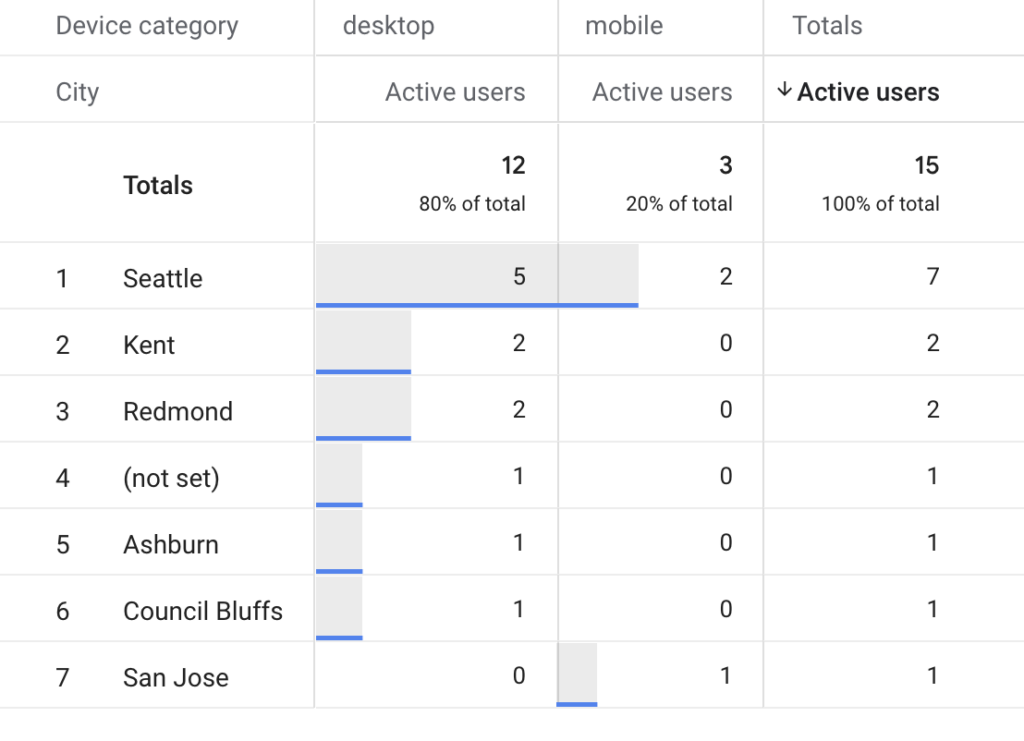
    I’ve also looked at users’ demographic data. Most of the visitors on my website are from Seattle and greater Seattle area such as Kent, Redmond and Auburn. There’s also one user from San Jose California. The below summary also tells me the platform that people are using to visit my website, with 12 using desktop and 3 using mobile devices.

    From the home screen, I can see that most of the website traffic occurred on the weekend. There are some events recorded throughout the week but at a much lower number compared to the weekends.

    Essay III. What have you started to see that you have no known/seen before in your site? (one paragraph)

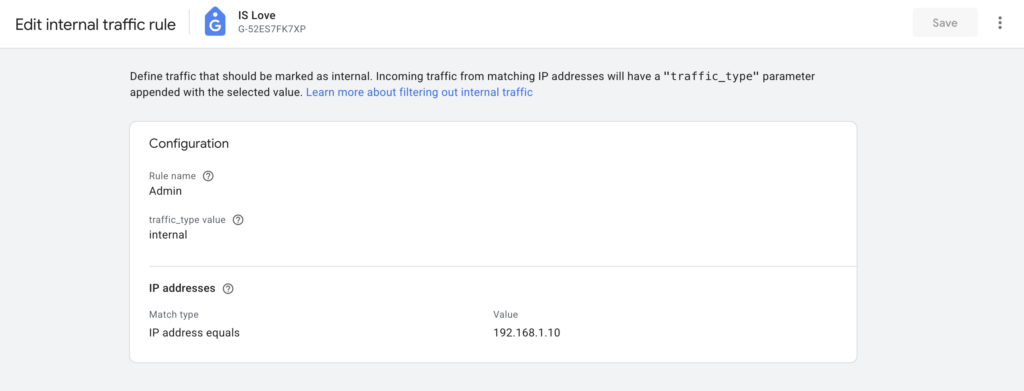
    I noticed that GA4 is tracking my own activity when I visit my own websites and make updates. I think the data collected over the past week is skewed due to internal admin activities and that it does not reflect the actual user trends. I did a quick google search and added an internal traffic rule to exclude my IP addresses (both desktop and mobile) from being counted in the reports. After setting up internal traffic rule, I also went to adjust data filer setting to exclude internal traffic.

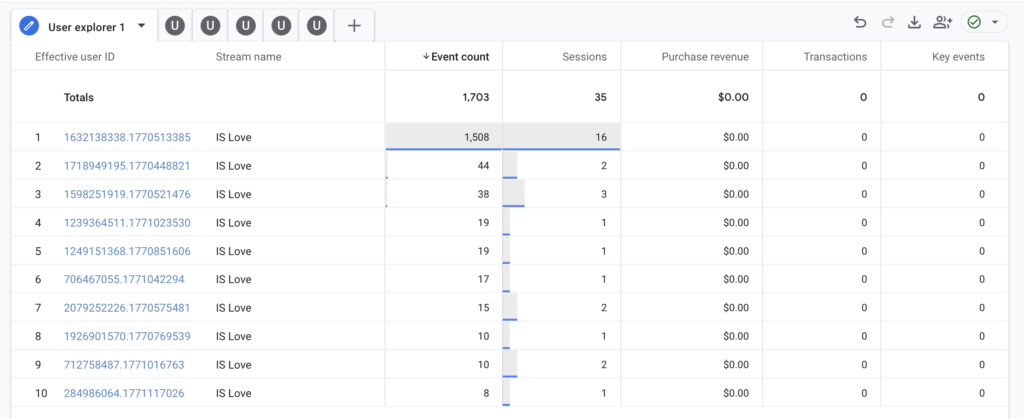
    Since the data might be skewed, I looked at GA4 Exploration tool and used User Explorer to get a list of user IDs. The first user with the biggest number of event count is most likely admin. There is a list of 10 user IDs. However, the total number of active user recorded was 15 including admin. There are most likely a few users with unidentified IDs.

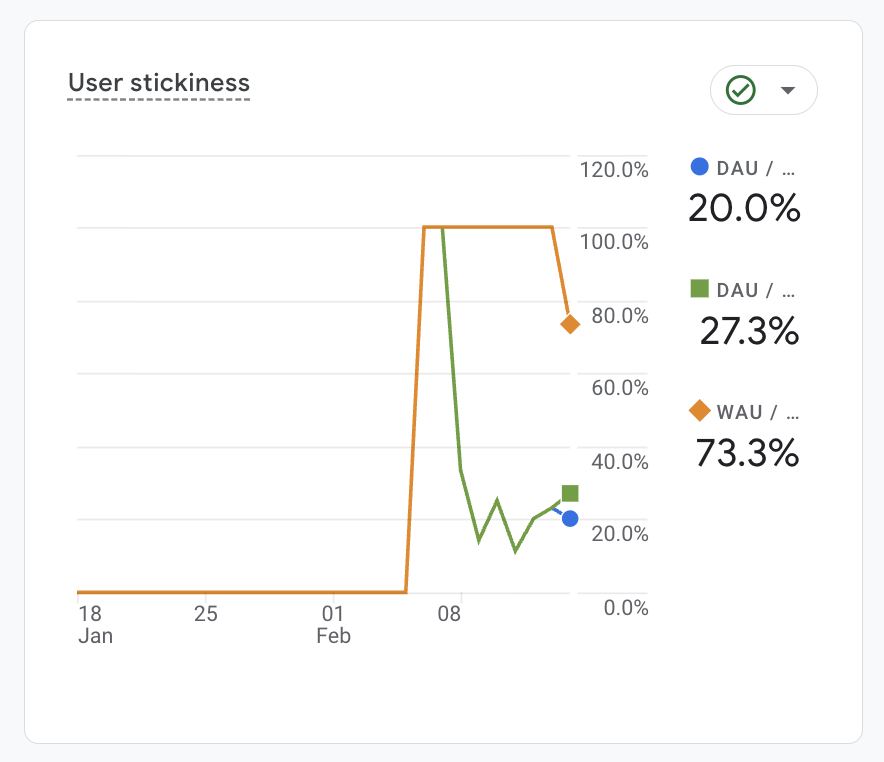
    A new metric that I learned was user stickiness, which measures how frequent the users return to the page. A 20% user loyalty is generally considered healthy. From the data collected, I have 4 returning users but this number might be including admin as well. According to report, my website is at about 30% for Daily Active User (DAU) stickiness, which falls in the healthy range. New data collected starting this week will exclude admin activities and will hopefully reflects a more accurate user retention metric.

  • A Week as a Mechanic

    Image from National Aviation Academy, “What Does an Aircraft Mechanic Do?”

    Over the past week, I had the opportunity to take a training session where I get to experience working as a mechanic. The training was designed for engineers to get a perspective on what a mechanic has to go through to build and assemble a product.

    It was a very unique experience for me as I get to learn how to use all the power tools that I don’t normally have a chance to, such as drill motor, hilok runner and rivet gun. Prior to the training, I did not know that it requires multiple steps to drill just a single fastener point, from positioning the point to drilling pilot hole and aligning parts to drilling full-size hole. Being a mechanic is physically demanding and takes a lot of skill to build a product that passes quality inspection. Oftentimes, rework is required for any job that does not meet quality check, and the process of rework can cause more damage to the part than what it started with.

    Toward the end of the week, I also got to learn a little bit about wiring, how to put together a wire bundle and bonding and grounding check. Electrical work requires certification and all mechanics have to go through rigorous training in order to be certified to work on the part. They also have to get tested to renew their certificates every year.

    This training experience has enabled me to get a better understanding of the build process and what it takes to manufacture a product. Since I work as a design engineer, I get to develop the product from the very early conceptual stage. Having this experience will definitely help be become a better designer and hopefully be able to make the work of the mechanics a little easier through simple and thoughtful design.

    The image above shows the assembly that I built over the course of the training. The assembly was released to me as a personal property to take home at the end of the week. It does not contain company proprietary information.

  • What is Compound Interest?

    I’m currently taking the Personal Financial Planning class as an elective at SU. In the past couple weeks I got to learn about of the topic of investment. There is the concept of compound interest that the instructor asked us to share with at least 5 new people and so I thought it would be a good idea to create a post and share with the class here.

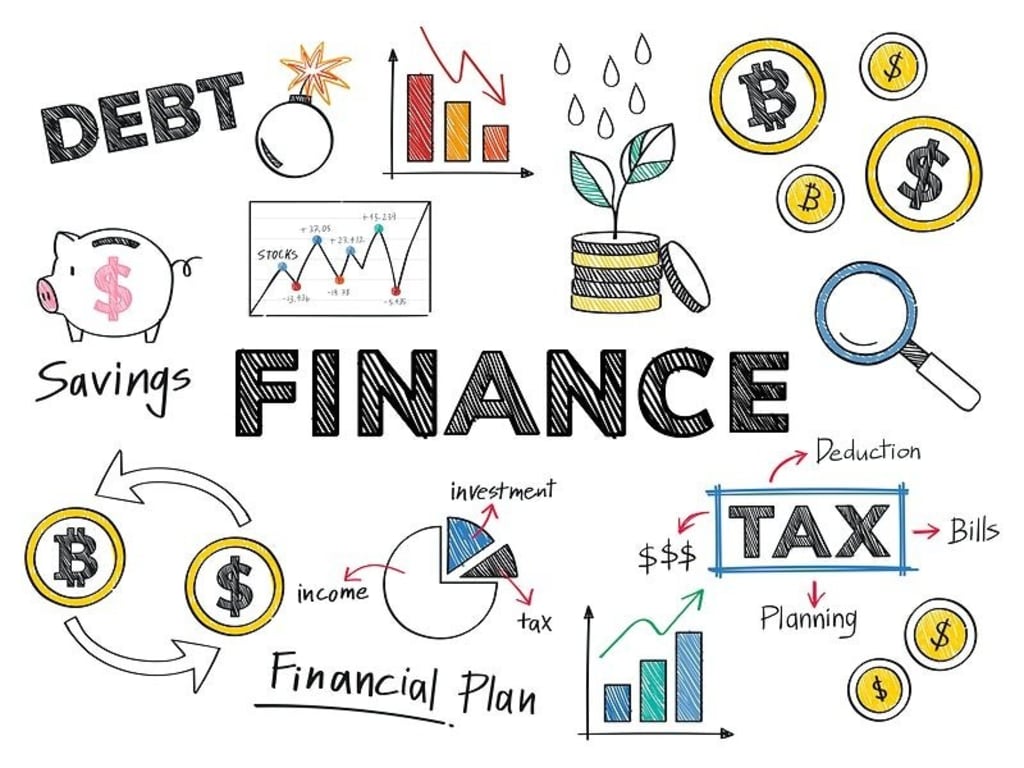
    Image by Alak via Education, “A Step-by-Step Guide to Building a Personal Financial Plan”

    Definition

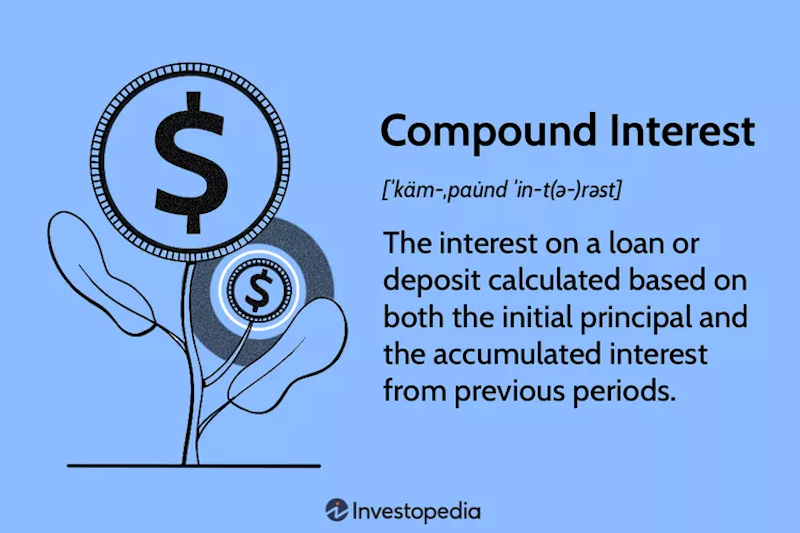
    Many of you might be familiar with the concept already but compound interest is often described as interest on interest, that is when the interest accumulated from the initial principal investment gets added to the total balance and yield additional interest in the next return period.

    Image by Jason Fernando via Investopedia, “The Power of Compound Interest: Calculations and Examples”

    How is Compound Interest Calculated?

    Compound interest allows money to grow exponentially and helps to boost your saving and investment assets in the long term.

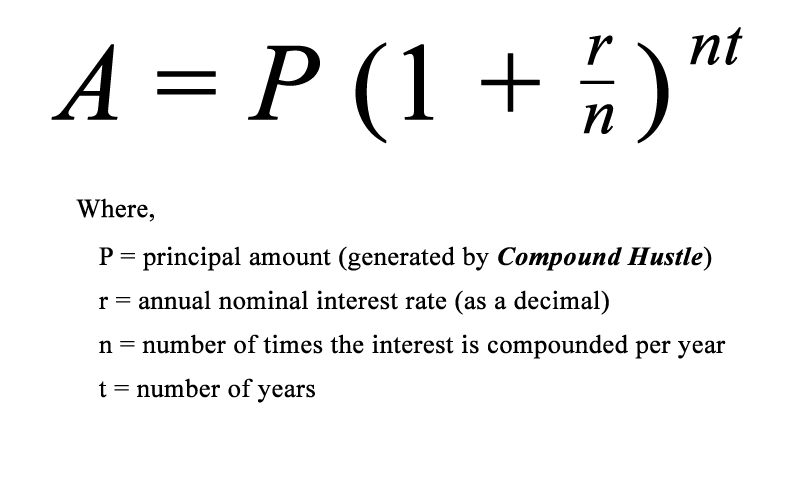
    Compound interest is calculated by the given formula below:

    Image by Frezelle via WordPress, “Finding interest rate and time in compound interest”

    For example, if you have $100,000 invested in a stock with an average rate of return of 8% annually for 20 years, without any additional money added, the initial principal of $100,000 will grow to about $466,095 at the end of the 20 year term.

    In this case A is the final value $466,095, P is the initial principle $100,000, r is the rate of return 0.08 (equivalent to 8%), n is 1 because the interest is compounded annually, and t is the investment term which is 20 years.

    Interest can be compounded annually (n=1), semi-annually (n=2), quarterly (n=4), monthly (n=12) and even daily (n=365). The more frequent interest is compounded, the more beneficial it is to the investor or lender.

    Pros and Cons of Compound Interest

    Compound interest can work against consumer making loan payments such as mortgage or car loan. Investment earnings from compound interest is also subjected to the same tax rate as income tax. The benefits of compound interest is minimal in the short term and it requires long term commitment to yield noticeable return.

    On the other hand, compound interest works in favor of investors and lenders. Compound interest promotes accelerated wealth growth and helps to protect the value of money against inflation. Longer term and greater compound interest frequency will result in significant growth, making it an ideal tool for retirement planning.

    Here is a link to a YouTube video on compound interest explained by Dave Ramsey that my instructor asked to share.

    Dave Ramsey: Wealth Building and Compound Interest

    References:

    Alak. “A Step-by-Step Guide to Building A Personal Financial Plan.” Education, 2025, vocal.media/education/a-step-by-step-guide-to-building-a-personal-financial-plan.

    Fernando, Jason. “The Power of Compound Interest: Calculations and Examples.” Investopedia, 22 Dec. 2025, www.investopedia.com/terms/c/compoundinterest.asp.

    Frezelle. “Finding Interest Rate and Time in Compound Interest.” Math Yahoo, 1 Oct. 2018, mathyahoo.wordpress.com/2018/10/01/finding-interest-rate-and-time-in-compound-interest/.

    “Dave Ramsey: Wealth Building and Compound Interest.” Let’s Make a Difference!, YouTube, 6 Aug. 2013, www.youtube.com/watch?v=eIOUGZcmauo.