Category: Financial Planning

  • Estate Planning Tools

    Image from Essential Estate Planning Tools

    What is Estate Planning?

    Estate planning is the process of arranging how your assets will be managed and distributed to beneficiaries after death.

    Source: https://www.legalzoom.com/

    Will and Educational Factors

    Source: https://www.legalzoom.com/
    Source: https://www.legalzoom.com/
    Source: https://www.legalzoom.com/
    Source: https://www.legalzoom.com/

    FreeWill

    Freewill is a free online estate planning tool that allows users to create a simple will in under 30 minutes. The Freewill website requires the user to sign up for a free account to get started. It has a very user-friendly dashboard that takes the user through a series of questions from start to finish. In the first article, Declarations, the user is asked to provide basic information such as marital status, dependents and approximate value of assets. In this section, the user is also able to define how the assets will be distributed among beneficiaries and declare if he/she wishes to donate any gift to charity. The second article, Executor Provisions, takes the user through identifying the executors (the persons appointed to manage a deceased person’s estate). The user can choose to have a no-contest clause, a provision stating that a beneficiary that challenges the validity of the will in court will be risking their part of the inheritance if they fail to win the trial. This clause is designed to maintain family harmony and ensure that the assets is distributed according to the deceased person’s intent. The user can also choose to add a self-proving affidavit, a separate document attached to the will as a testament that the will has been signed and witnessed in front of a notary public.

    After going through all the questions and provide the necessary information, the user can review and download a copy of their will free of charge. The will needs to be signed in front of a notary public to become legally valid. The testator, creator of the will needs to store the will in a safe location and inform the executors of the location so that it can be found after death. In addition, the Freewill.com website also offer tool to create other types of documents such as Advanced Healthcare Directive (a document that outlines medical treatment preferences if a person is unable to make decision due to illness), Financial Power of Attorney (a document that appoints someone else to make financial design if the person is unable to) and Beneficiary Designation (document that distributes assets not covered in will or other documents).

    The FreeWill online tool is ideal for simple cases where the person does not have a lot assets but it lacks the ability to handle complex estates. The tool cannot provide personalized advice and the legal support that user would be able to get from an attorney. There is limited customization available and the form is designed to be one size fit all. The site makes money by asking the users if they wish to donate to charity and that is how it is able to offer its service for free. Thus, the users need to be cautious and avoid making any unintended decision. It is best to consult an attorney in cases of substantial assets involving businesses, and complex family structure.

    LawDepot

    LawDepot is another online estate planning tool that allows the users to DIY last will and testament document. Similar to FreeWill, to create a will, the users need to go through a series of questions where they are asked to identify executors and beneficiaries. However, this tool does not offer free download of the document and requires the users to sign up for an online subscription costing between $9 to $13 per month. Individual documents can also be purchased at a cost between $8 to $119 depending on complexity. There is a one-week free trial that the users can take advantage of if they are just starting out and want to get a quick free experience with estate planning. With subscription, the user can get access of many different types of documents including Power of Attorney, Gift Deed, Revocable Living Trust (a legal document that outline assets distribution to beneficiaries similar to a will but allow assets to bypass probate) and many more. Aside from estate planning, the LawDepot website also offer real estate forms such as lease agreement and quitclaim deed, as well as business plan and contract. The tool offers more customization options compare to FreeWill with a wide range of documents available. These forms are good for simple cases but again might not be suited for large complex assets. There is no legal advice or support from professional. The user can choose to contact a lawyer or attorney for additional support through LawDepot online website, but this service is not included as part of the subscription.

    Rocket Lawyer

    Rocket Lawyer is an online website that also offers tool for DIY will but requires a subscription. There is a free trial available for 7 days similar to LawDepot. After the free trial period, the user has the options to pay a monthly subscription of $39.99 to or $239.88 for an annual subscription which can be paid in 4 installments throughout the year. The users can fill out the last will and testament template by answering a series of questions similar to the previous tools discussed above. One interesting feature in this will template that is not offered in the previous tools is that the users are asked if they want to purchase an executor bond (a court requirement for the person appointed to manage the deceased person’s assets to purchase a surety bond, an insurance protecting beneficiaries from executor fraud) and if they would like for the executor to receive compensation for serving. There are also specific questions regarding the executor personal liability in performing the duty and if the executor is allowed handle disputes between beneficiaries. Similar to other online estate planning tools, Rocket Lawer offers convenience and speed for individual with simple assets. There is a variety to documents available for different legal needs. With DIY tools, there is always a risk of error if the user is not at all familiar with the terms used in estate planning. Personalized advice or professional support is not included in the standard subscription, and the user will be charged additional fees for the special service.

    Risks of Using Online Estate Planning Tools

    Online will-making tools do not offer tailored advice for different situations, and the user is responsible for understanding the terms and provisions and providing accurate information of their assets. The document is not reviewed by a professional and thus any error made by the user can lead to legal dispute and high long-term cost. The asset distribution might not be optimized for tax planning. Estate planning requires more than just simply creating a will or a document. The user needs to have an understanding of the legal processes (such as probate) involved and the timeline for when and how the assets will be distributed. This is important information that are not well explained on these online platforms. Online platforms have standard templates that are designed to be one size fit all. These templates might not be valid for all due to different state laws. Online tools will not be able to guide users through updating their will for major life changes such as getting married or divorced or loss of a beneficiary.
    Click on links below to try out these estate planning tools

    FreeWill

    LawDepot

    Rocket Lawyer

  • Free Financial Planning Tools

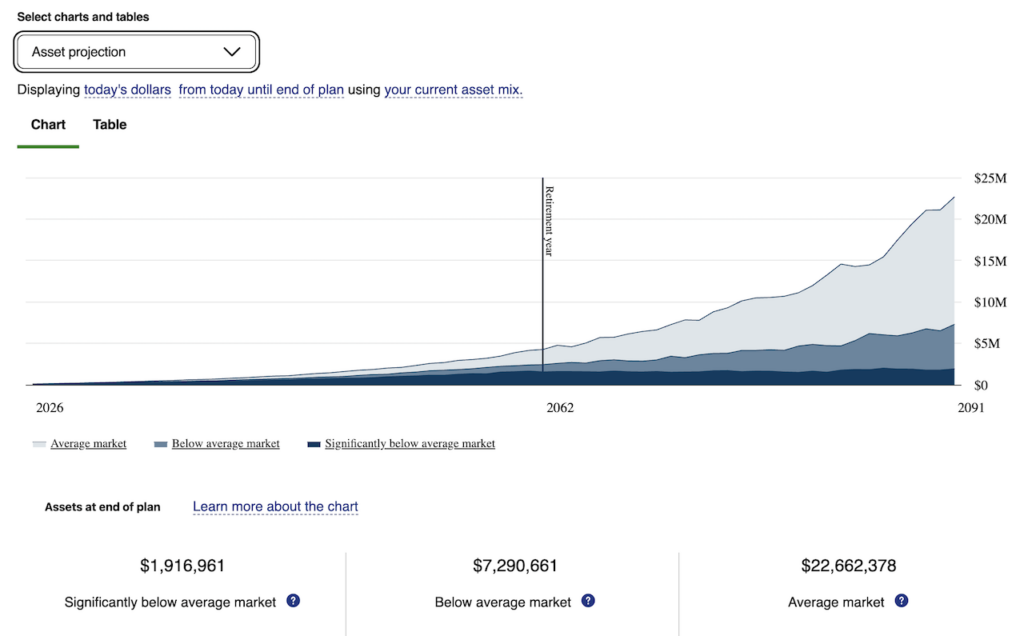
    Fidelity is one of the largest brokerage companies in the world offering financial services including free online financial planning tools. The Fidelity Retirement Planning dashboard allows users to create a personal household profile (income, bonus, commission), retirement profile (retirement age, state, life expectancy), retirement expenses (can use automatic estimate or define user input), current assets (401k, saving, investment, real estate) and retirement income (social security, can use automatic estimate or manual input). The result from the analysis is a basic graph showing projection for 3 different scenarios, average market, below average market and significantly below average market.

    The tool is very simple and easy to use. If the user already has a Fidelity account for 401k or IRA, all of these assets are automatically linked to the tool to be used in the analysis. These types of accounts can also be added manually. The user also has option to manually add in other assets. The analysis result is very easy to interpret and can be viewed with a graph or a table showing the growth of the total assets through each year until the final year of life expectancy.

    Some of the limitations of the tool is that it does not offer different rate of return assumption. Retirement saving rate is set to the user’s current 401k contribution rate and cannot be adjusted easily, which limits the user’s ability to see what happens if they decide to save more or less. It is not clear how the tool takes into account the user’s current expenses and how that factors into their saving plan and retirement projection.

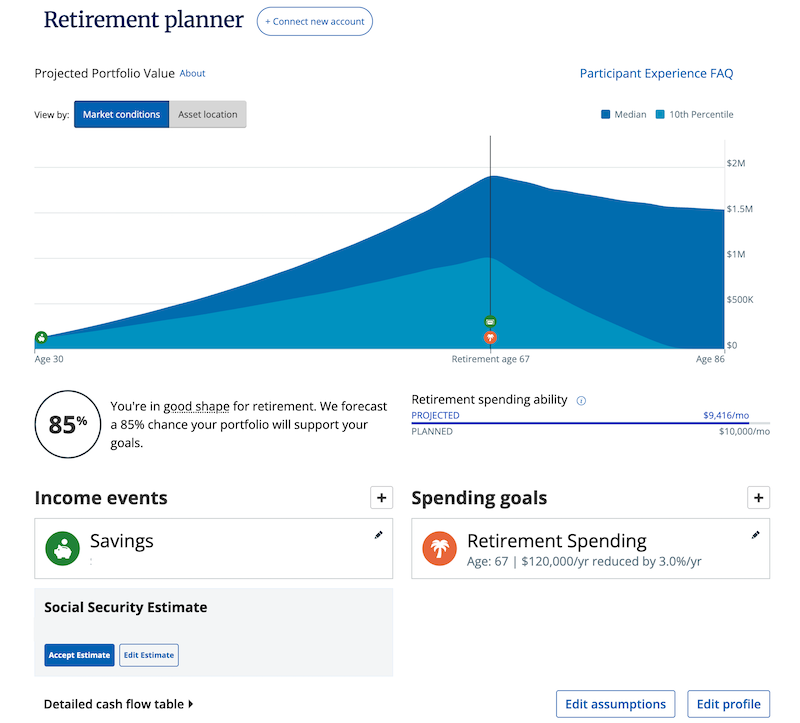
    Empower is another financial services company providing free financial planning tool that allows users to track finances, budgeting and retirement planning. The tool requires setting up an Empower account and link all personal information such as bank accounts, retirement accounts, mortgage, loans, etc. In the retirement planner, the user can input their expected yearly saving, any other cash balance and a percentage of saving increase per year. The user can also adjust retirement age, retirement spending and percentage of spending decrease per year until reaching a spending minimum. There is also a social security estimate provided by the software but can be manually adjusted by the user. There are a few assumptions that the user can manipulate such as effective tax rate, inflation rate and life expectancy. The analysis result shows a graph of the projected portfolio over the projected lifespan with a success rate given in percentage.

    One drawback of the tool is that it requires the user to link personal financial accounts, which might be viewed as a security concern. It also has limited capability in term of making adjustment to saving plan or adding a spouse to the profile. Similar to Fidelity Retirement Planning, this tool assumes a fixed saving rate and does not take into account monthly expenses and how variations might factor into retirement projection.

    On the other hand, one advantage of the tool is that it allows the user to create multiple retirement plans, simulate recession at a certain year during the user’s lifetime, compare these different scenarios and evaluate the rate of success for each plan. Overall, the tool has a very user-friendly interface with an easy learning curve suitable for beginners looking into retirement planning.

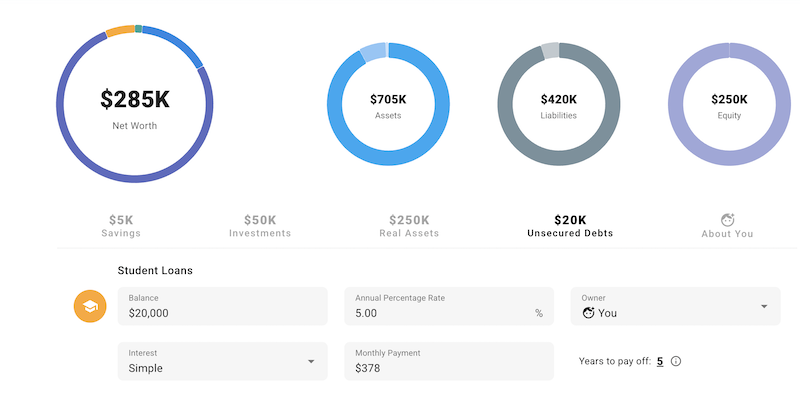
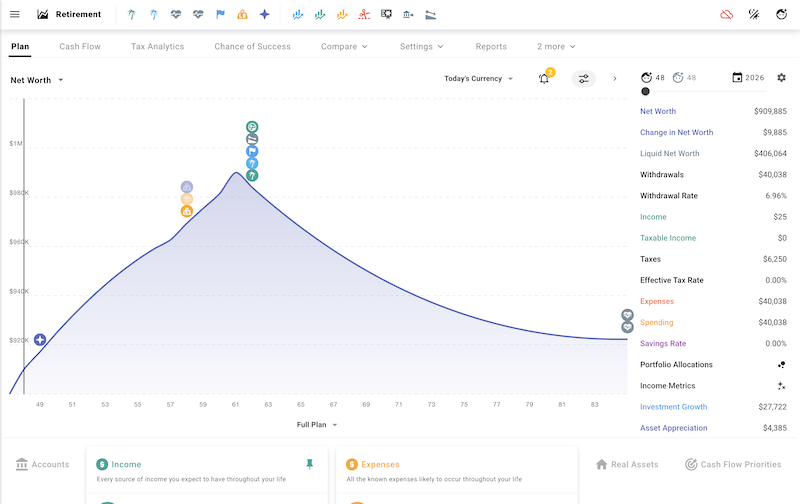
    ProjectionLab Financial Planning tool has a free version as well as premium for advanced users. The free version offers full planning capabilities, but some advanced reporting is limited to premium members only. Aside from the basics, this tool has an option to add life milestones such as getting married, having kids, new jobs or moving to a different place. The user can also input current living expenses and cash flow priorities such as paying debt and mortgage.

    The tool requires the user to manually input all of their information. However, there is no data preservation in the free version, and the user would have to manually input all the numbers again at their next visit. The tool utilizes Monte Carlo probability analysis to simulate the chance of success in reaching retirement goal. A huge drawback of the tool is that it has a high learning curve due to the level of customization and complexity in trying to simulate real life scenarios.

    Fidelity

    Empower

    ProjectionLab

  • What is Compound Interest?

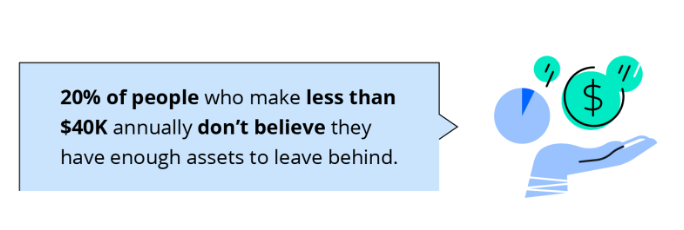
    I’m currently taking the Personal Financial Planning class as an elective at SU. In the past couple weeks I got to learn about of the topic of investment. There is the concept of compound interest that the instructor asked us to share with at least 5 new people and so I thought it would be a good idea to create a post and share with the class here.

    Image by Alak via Education, “A Step-by-Step Guide to Building a Personal Financial Plan”

    Definition

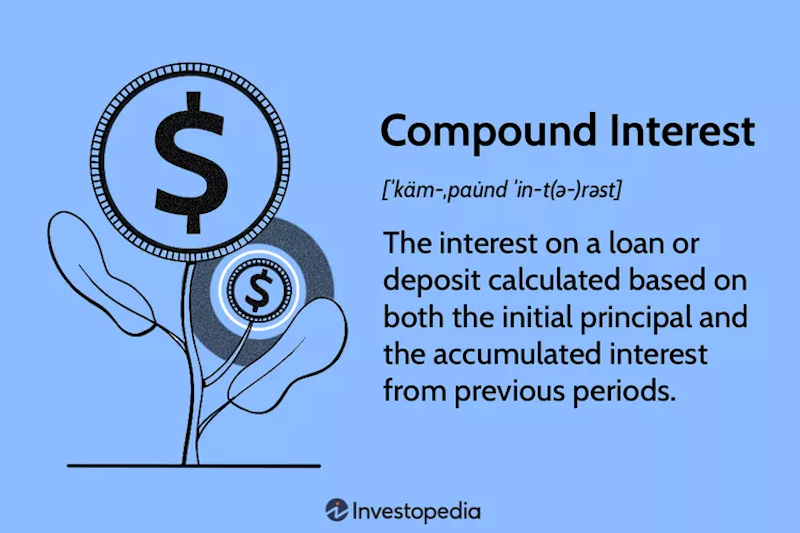
    Many of you might be familiar with the concept already but compound interest is often described as interest on interest, that is when the interest accumulated from the initial principal investment gets added to the total balance and yield additional interest in the next return period.

    Image by Jason Fernando via Investopedia, “The Power of Compound Interest: Calculations and Examples”

    How is Compound Interest Calculated?

    Compound interest allows money to grow exponentially and helps to boost your saving and investment assets in the long term.

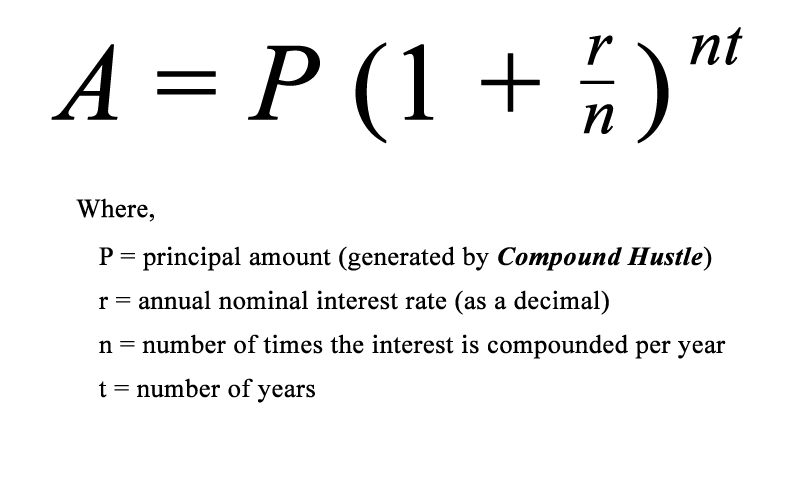
    Compound interest is calculated by the given formula below:

    Image by Frezelle via WordPress, “Finding interest rate and time in compound interest”

    For example, if you have $100,000 invested in a stock with an average rate of return of 8% annually for 20 years, without any additional money added, the initial principal of $100,000 will grow to about $466,095 at the end of the 20 year term.

    In this case A is the final value $466,095, P is the initial principle $100,000, r is the rate of return 0.08 (equivalent to 8%), n is 1 because the interest is compounded annually, and t is the investment term which is 20 years.

    Interest can be compounded annually (n=1), semi-annually (n=2), quarterly (n=4), monthly (n=12) and even daily (n=365). The more frequent interest is compounded, the more beneficial it is to the investor or lender.

    Pros and Cons of Compound Interest

    Compound interest can work against consumer making loan payments such as mortgage or car loan. Investment earnings from compound interest is also subjected to the same tax rate as income tax. The benefits of compound interest is minimal in the short term and it requires long term commitment to yield noticeable return.

    On the other hand, compound interest works in favor of investors and lenders. Compound interest promotes accelerated wealth growth and helps to protect the value of money against inflation. Longer term and greater compound interest frequency will result in significant growth, making it an ideal tool for retirement planning.

    Here is a link to a YouTube video on compound interest explained by Dave Ramsey that my instructor asked to share.

    Dave Ramsey: Wealth Building and Compound Interest

    References:

    Alak. “A Step-by-Step Guide to Building A Personal Financial Plan.” Education, 2025, vocal.media/education/a-step-by-step-guide-to-building-a-personal-financial-plan.

    Fernando, Jason. “The Power of Compound Interest: Calculations and Examples.” Investopedia, 22 Dec. 2025, www.investopedia.com/terms/c/compoundinterest.asp.

    Frezelle. “Finding Interest Rate and Time in Compound Interest.” Math Yahoo, 1 Oct. 2018, mathyahoo.wordpress.com/2018/10/01/finding-interest-rate-and-time-in-compound-interest/.

    “Dave Ramsey: Wealth Building and Compound Interest.” Let’s Make a Difference!, YouTube, 6 Aug. 2013, www.youtube.com/watch?v=eIOUGZcmauo.