Category: IS 5320 Assignment 6

  • HW6 Summary

    Time Log – time spent on other students’ sites:

    Date: Feb 11, 2026, From 9:30pm to 10:00 pm

    Date: Feb. 12, 2026, From 9:15pm to 10:00pm

    Date: Feb. 13, 2026, From 9:30pm to 10:00pm

    Date: Feb. 14, 2026, From 3:00pm to 4:00pm

    Date: Feb. 14, 2026, From 10:00pm to 10:30pm

    Date: Feb. 15, 2026, From 11:30am to 12:00pm

    Date: Feb. 15, 2026, From 5:30pm to 6:00pm

    Essay I. Summary of your activities in your contents including new contents created (one paragraph). Provide all the hyperlinks (clickable) of new contents you have created this week.

    I installed a plug-in Robo Gallery to my website to display images of famous landmarks in Seattle. This gallery can be seen from the homepage. I wanted to add images to my homepage to make it more visually appealing. Image sources are displayed on the bottom left corner.

    Homepage

    I also created a new page called My Learning to include the two new posts that I created this week. The My Learning page is linked below.

    My Learning

    In My Learning page, the two new posts are displayed using an automatic slider. I’ve also added a gallery of recommended books on investment topics at the end of the page with links to buy from Amazon for anyone who is interested. The links to the new posts are below.

    1st post: What is compound interest?

    2nd post: A week as a mechanic

    A HW6 page is added under HWs menu with link below

    HW6

    The HW6 page includes 3 posts, HW6 Summary and the two posts that I created under My Learning.

    I addition to new contents, I also went back and make small changes to my existing menu. I updated the More Links menu page to include links to the practice HTML. I also reformatted the IT Trends page and My Life page to include feature images.

    More Links

    IT Trends

    My Life

    Essay II: Summary of your “Exploration in GA4 (add a screenshot) (one paragraph)

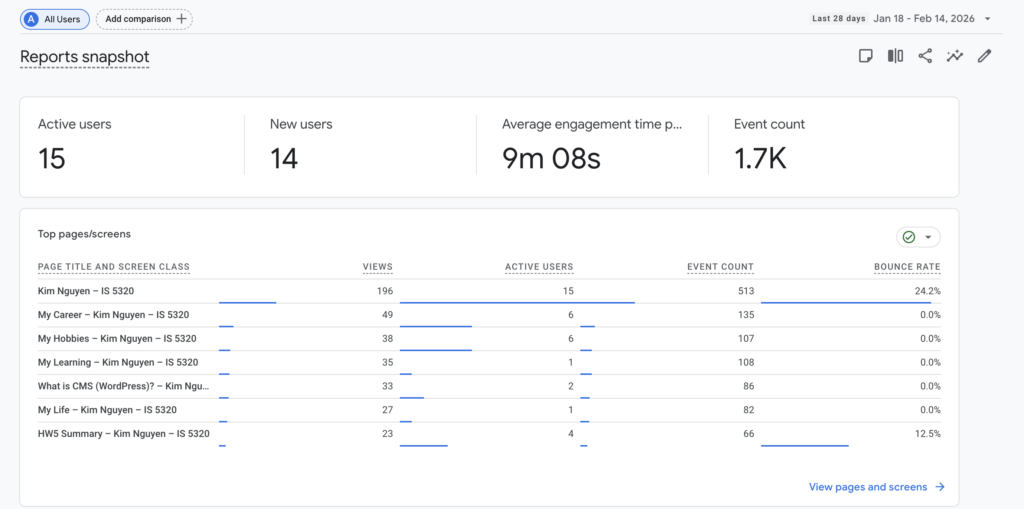
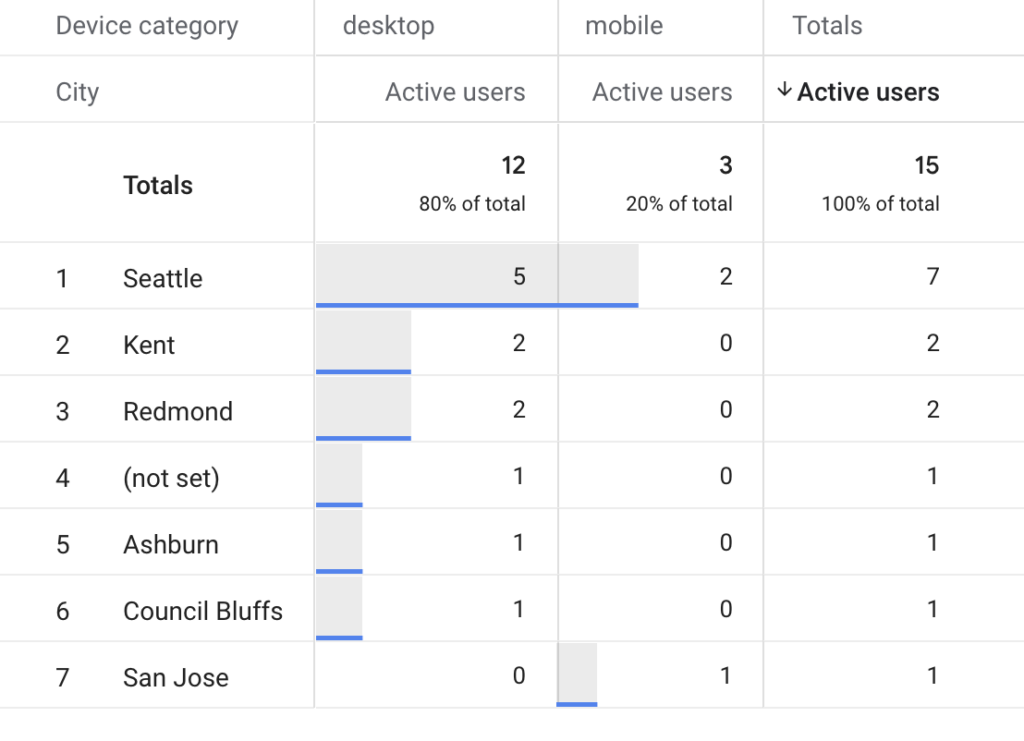
    Below is a screenshot of GA4 user report for my website. There are 14 new users who visited my website. This report also tells me how many views each of my page is getting. Some of the popular posts with the most views are My Career and My Hobbies.
    I’ve also looked at users’ demographic data. Most of the visitors on my website are from Seattle and greater Seattle area such as Kent, Redmond and Auburn. There’s also one user from San Jose California. The below summary also tells me the platform that people are using to visit my website, with 12 using desktop and 3 using mobile devices.
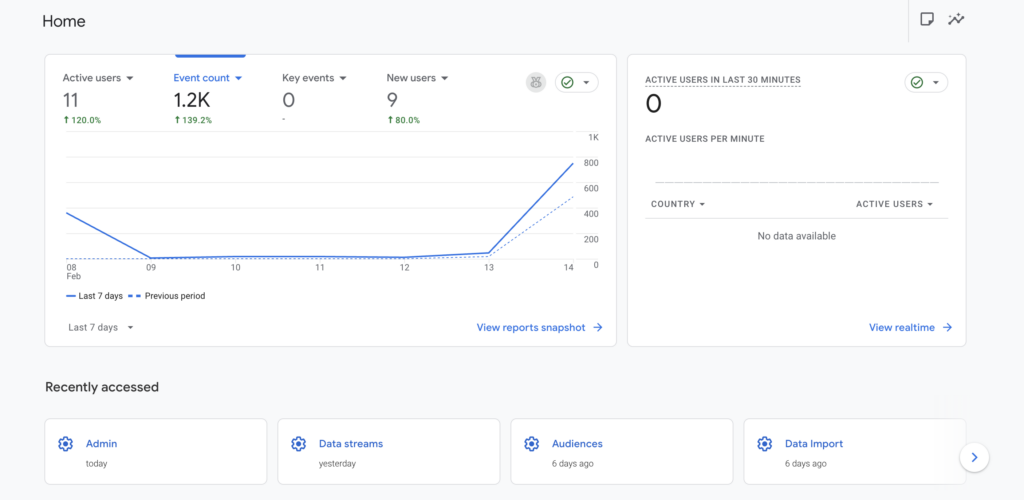
    From the home screen, I can see that most of the website traffic occurred on the weekend. There are some events recorded throughout the week but at a much lower number compared to the weekends.
    Essay III. What have you started to see that you have no known/seen before in your site? (one paragraph)

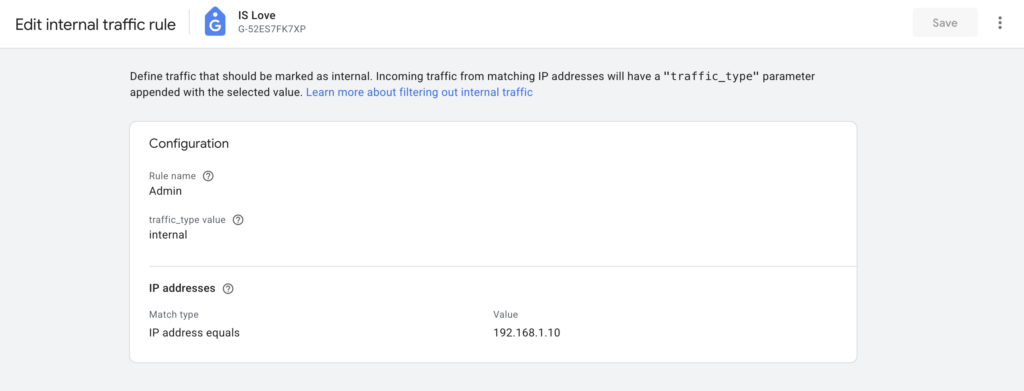
    I noticed that GA4 is tracking my own activity when I visit my own websites and make updates. I think the data collected over the past week is skewed due to internal admin activities and that it does not reflect the actual user trends. I did a quick google search and added an internal traffic rule to exclude my IP addresses (both desktop and mobile) from being counted in the reports. After setting up internal traffic rule, I also went to adjust data filer setting to exclude internal traffic.
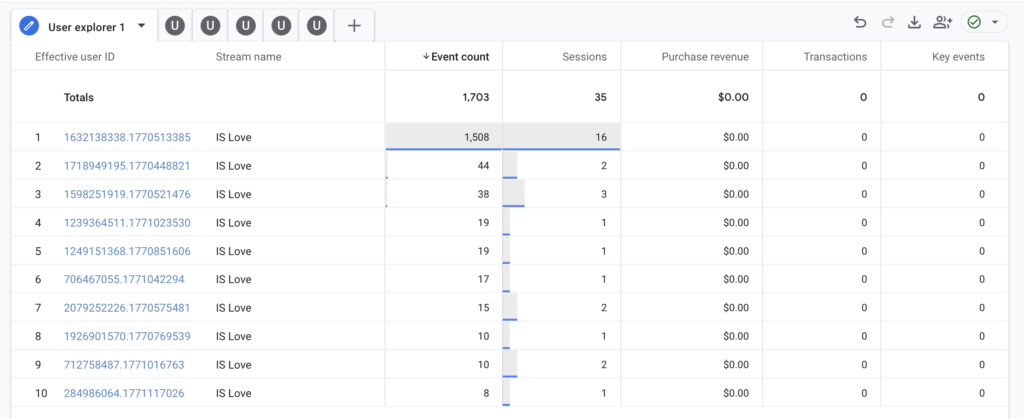
    Since the data might be skewed, I looked at GA4 Exploration tool and used User Explorer to get a list of user IDs. The first user with the biggest number of event count is most likely admin. There is a list of 10 user IDs. However, the total number of active user recorded was 15 including admin. There are most likely a few users with unidentified IDs.
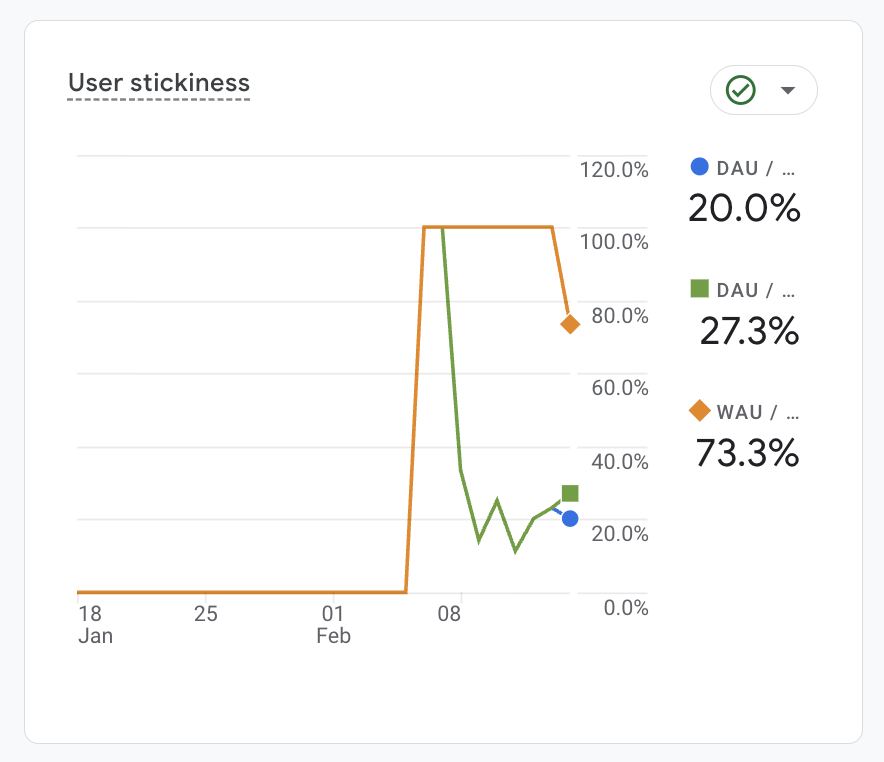
    A new metric that I learned was user stickiness, which measures how frequent the users return to the page. A 20% user loyalty is generally considered healthy. From the data collected, I have 4 returning users but this number might be including admin as well. According to report, my website is at about 30% for Daily Active User (DAU) stickiness, which falls in the healthy range. New data collected starting this week will exclude admin activities and will hopefully reflects a more accurate user retention metric.

  • A Week as a Mechanic

    Image from National Aviation Academy, “What Does an Aircraft Mechanic Do?”

    Over the past week, I had the opportunity to take a training session where I get to experience working as a mechanic. The training was designed for engineers to get a perspective on what a mechanic has to go through to build and assemble a product.

    It was a very unique experience for me as I get to learn how to use all the power tools that I don’t normally have a chance to, such as drill motor, hilok runner and rivet gun. Prior to the training, I did not know that it requires multiple steps to drill just a single fastener point, from positioning the point to drilling pilot hole and aligning parts to drilling full-size hole. Being a mechanic is physically demanding and takes a lot of skill to build a product that passes quality inspection. Oftentimes, rework is required for any job that does not meet quality check, and the process of rework can cause more damage to the part than what it started with.

    Toward the end of the week, I also got to learn a little bit about wiring, how to put together a wire bundle and bonding and grounding check. Electrical work requires certification and all mechanics have to go through rigorous training in order to be certified to work on the part. They also have to get tested to renew their certificates every year.

    This training experience has enabled me to get a better understanding of the build process and what it takes to manufacture a product. Since I work as a design engineer, I get to develop the product from the very early conceptual stage. Having this experience will definitely help be become a better designer and hopefully be able to make the work of the mechanics a little easier through simple and thoughtful design.

    The image above shows the assembly that I built over the course of the training. The assembly was released to me as a personal property to take home at the end of the week. It does not contain company proprietary information.

  • What is Compound Interest?

    I’m currently taking the Personal Financial Planning class as an elective at SU. In the past couple weeks I got to learn about of the topic of investment. There is the concept of compound interest that the instructor asked us to share with at least 5 new people and so I thought it would be a good idea to create a post and share with the class here.

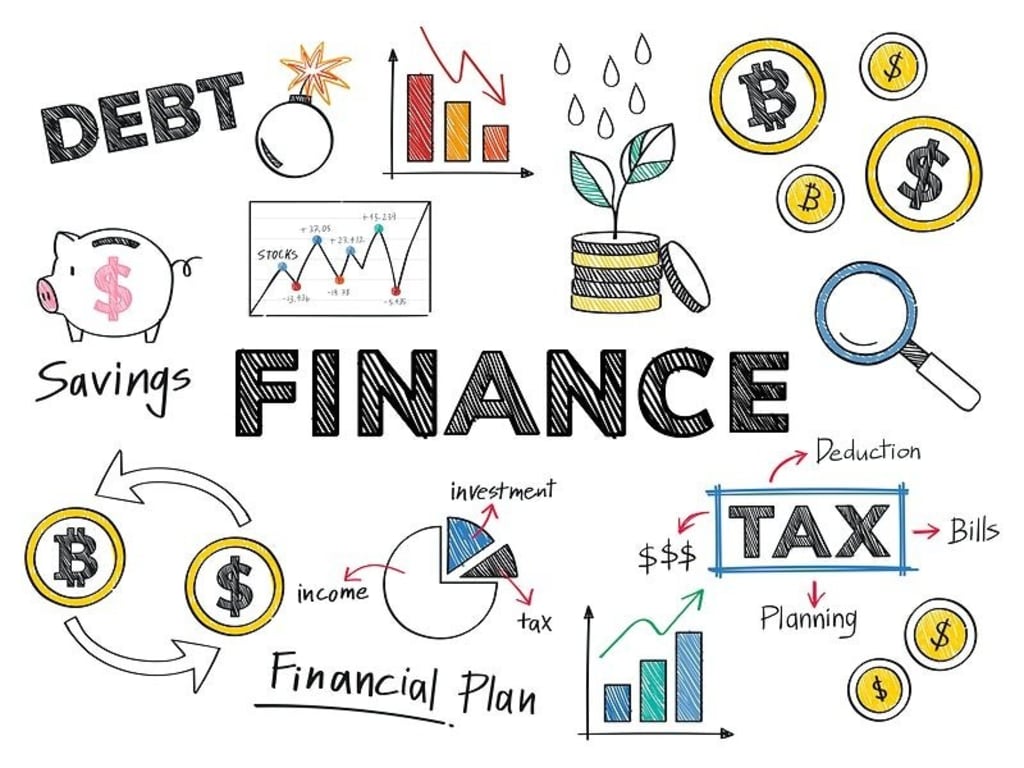
    Image by Alak via Education, “A Step-by-Step Guide to Building a Personal Financial Plan”

    Definition

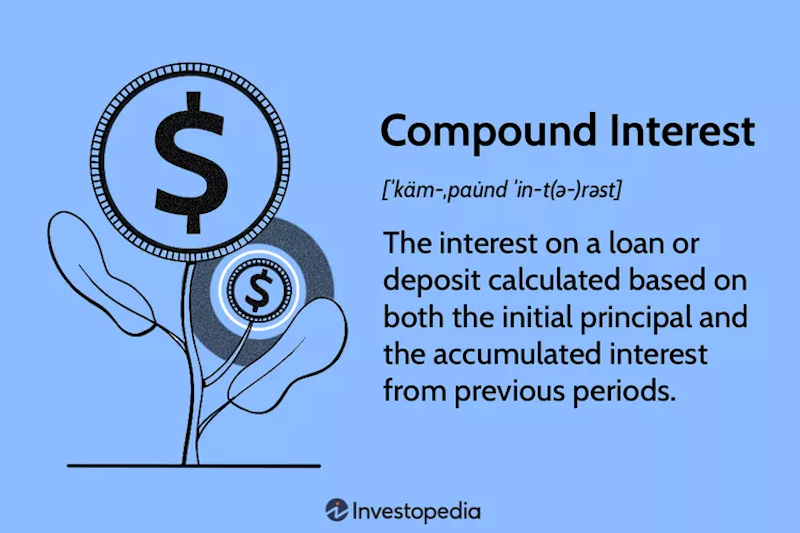
    Many of you might be familiar with the concept already but compound interest is often described as interest on interest, that is when the interest accumulated from the initial principal investment gets added to the total balance and yield additional interest in the next return period.

    Image by Jason Fernando via Investopedia, “The Power of Compound Interest: Calculations and Examples”

    How is Compound Interest Calculated?

    Compound interest allows money to grow exponentially and helps to boost your saving and investment assets in the long term.

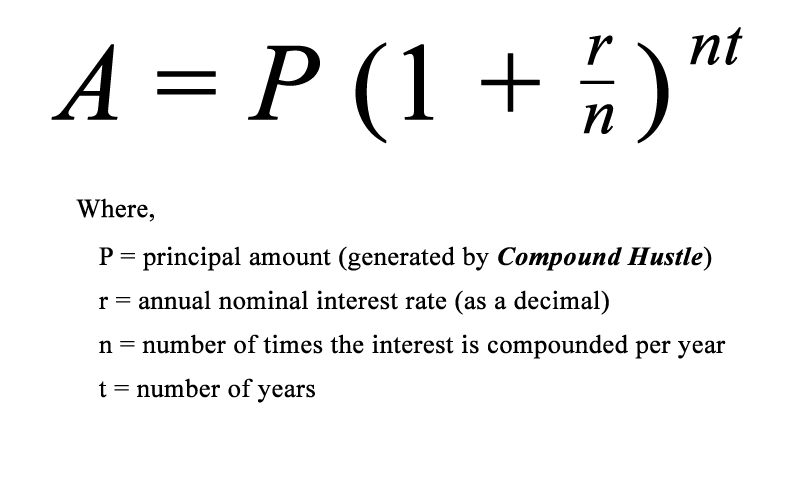
    Compound interest is calculated by the given formula below:

    Image by Frezelle via WordPress, “Finding interest rate and time in compound interest”

    For example, if you have $100,000 invested in a stock with an average rate of return of 8% annually for 20 years, without any additional money added, the initial principal of $100,000 will grow to about $466,095 at the end of the 20 year term.

    In this case A is the final value $466,095, P is the initial principle $100,000, r is the rate of return 0.08 (equivalent to 8%), n is 1 because the interest is compounded annually, and t is the investment term which is 20 years.

    Interest can be compounded annually (n=1), semi-annually (n=2), quarterly (n=4), monthly (n=12) and even daily (n=365). The more frequent interest is compounded, the more beneficial it is to the investor or lender.

    Pros and Cons of Compound Interest

    Compound interest can work against consumer making loan payments such as mortgage or car loan. Investment earnings from compound interest is also subjected to the same tax rate as income tax. The benefits of compound interest is minimal in the short term and it requires long term commitment to yield noticeable return.

    On the other hand, compound interest works in favor of investors and lenders. Compound interest promotes accelerated wealth growth and helps to protect the value of money against inflation. Longer term and greater compound interest frequency will result in significant growth, making it an ideal tool for retirement planning.

    Here is a link to a YouTube video on compound interest explained by Dave Ramsey that my instructor asked to share.

    Dave Ramsey: Wealth Building and Compound Interest

    References:

    Alak. “A Step-by-Step Guide to Building A Personal Financial Plan.” Education, 2025, vocal.media/education/a-step-by-step-guide-to-building-a-personal-financial-plan.

    Fernando, Jason. “The Power of Compound Interest: Calculations and Examples.” Investopedia, 22 Dec. 2025, www.investopedia.com/terms/c/compoundinterest.asp.

    Frezelle. “Finding Interest Rate and Time in Compound Interest.” Math Yahoo, 1 Oct. 2018, mathyahoo.wordpress.com/2018/10/01/finding-interest-rate-and-time-in-compound-interest/.

    “Dave Ramsey: Wealth Building and Compound Interest.” Let’s Make a Difference!, YouTube, 6 Aug. 2013, www.youtube.com/watch?v=eIOUGZcmauo.