I’m currently taking the Personal Financial Planning class as an elective at SU. In the past couple weeks I got to learn about of the topic of investment. There is the concept of compound interest that the instructor asked us to share with at least 5 new people and so I thought it would be a good idea to create a post and share with the class here.
Definition
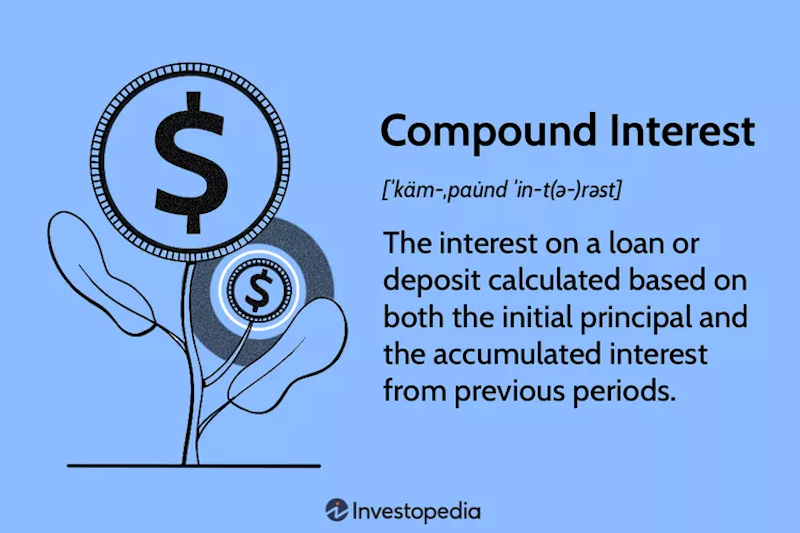
Many of you might be familiar with the concept already but compound interest is often described as interest on interest, that is when the interest accumulated from the initial principal investment gets added to the total balance and yield additional interest in the next return period.
How is Compound Interest Calculated?
Compound interest allows money to grow exponentially and helps to boost your saving and investment assets in the long term.
Compound interest is calculated by the given formula below:
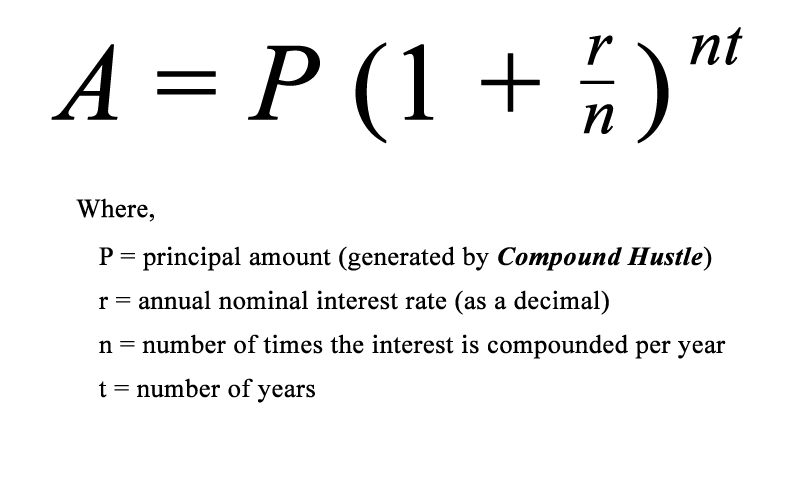
For example, if you have $100,000 invested in a stock with an average rate of return of 8% annually for 20 years, without any additional money added, the initial principal of $100,000 will grow to about $466,095 at the end of the 20 year term.
In this case A is the final value $466,095, P is the initial principle $100,000, r is the rate of return 0.08 (equivalent to 8%), n is 1 because the interest is compounded annually, and t is the investment term which is 20 years.
Interest can be compounded annually (n=1), semi-annually (n=2), quarterly (n=4), monthly (n=12) and even daily (n=365). The more frequent interest is compounded, the more beneficial it is to the investor or lender.
Pros and Cons of Compound Interest
Compound interest can work against consumer making loan payments such as mortgage or car loan. Investment earnings from compound interest is also subjected to the same tax rate as income tax. The benefits of compound interest is minimal in the short term and it requires long term commitment to yield noticeable return.
On the other hand, compound interest works in favor of investors and lenders. Compound interest promotes accelerated wealth growth and helps to protect the value of money against inflation. Longer term and greater compound interest frequency will result in significant growth, making it an ideal tool for retirement planning.
Here is a link to a YouTube video on compound interest explained by Dave Ramsey that my instructor asked to share.
Dave Ramsey: Wealth Building and Compound Interest
References:
Alak. “A Step-by-Step Guide to Building A Personal Financial Plan.” Education, 2025, vocal.media/education/a-step-by-step-guide-to-building-a-personal-financial-plan.
Fernando, Jason. “The Power of Compound Interest: Calculations and Examples.” Investopedia, 22 Dec. 2025, www.investopedia.com/terms/c/compoundinterest.asp.
Frezelle. “Finding Interest Rate and Time in Compound Interest.” Math Yahoo, 1 Oct. 2018, mathyahoo.wordpress.com/2018/10/01/finding-interest-rate-and-time-in-compound-interest/.
“Dave Ramsey: Wealth Building and Compound Interest.” Let’s Make a Difference!, YouTube, 6 Aug. 2013, www.youtube.com/watch?v=eIOUGZcmauo.